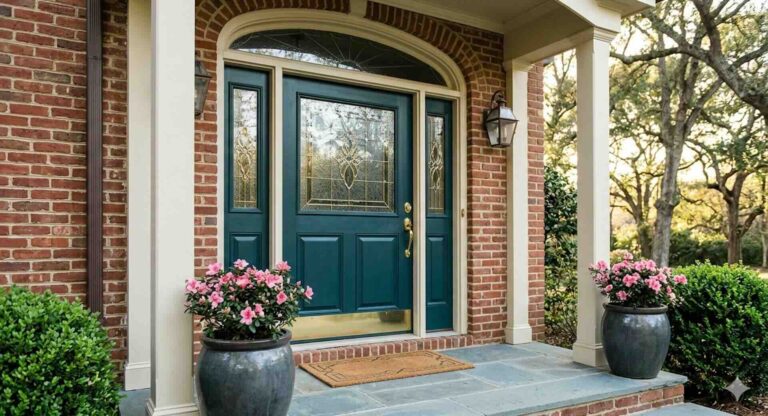











For most homeowners across Alabama, Georgia, Tennessee, and the Carolinas, fiberglass entry doors outperform wood in the Southeast’s humid, storm-prone climate thanks to superior moisture resistance, better insulation, and dramatically lower maintenance. On the other hand, well-protected wood doors still have a place on shaded, architecturally traditional entryways.
Key Takeaways
Fiberglass doors resist warping, swelling, rotting, and insect damage, the four biggest threats across the humid Southeast.
Wood doors can still work beautifully from the Smokies to the Piedmont, but almost exclusively under a deep porch or overhang and with committed maintenance.
Fiberglass typically delivers up to five times the insulating value of a comparable solid wood door, which translates to real savings on summer cooling bills.
ENERGY STAR-certified doors may qualify for a federal tax credit of 30% of the product cost, up to $250 per door and $500 annually through 2032.
Across a 20-year timeframe, fiberglass usually wins on total cost of ownership; wood wins on character and resale appeal for the right home.
Termite pressure is a concern across the Southeast; fiberglass removes that risk entirely.
Before you spend a thousand dollars on curb appeal, ask yourself whether your new front door will still look like that in three summers? That’s the test in Birmingham, Atlanta, Nashville, and Charlotte. Nashville mornings in August routinely hit 90 percent relative humidity. Atlanta averages 50 inches of rain a year. And your front door stands in the front row of that fight.
Why Entry Door Material Matters More in Humid Climates
The Southeast is not a kind environment for exterior building materials. Between Gulf-fed moisture, long cooling seasons, heavy thunderstorms, and ultraviolet (UV)-heavy summers, our region tests every square inch of your home’s envelope.
Your front door sits in the worst possible spot for this. It faces direct weather, absorbs radiant heat, and separates your conditioned air from muggy outdoor reality dozens of times a day.
A poor choice here shows up fast. You’ll notice:
- Doors that stick in August and rattle in January as materials swell and shrink
- Peeling finishes and chalky fade on south-facing as well as west-facing entries
- Rot along the bottom rail where wind-driven rain pools
- Rising energy bills as weatherstripping compresses around a warped slab
- Termite activity following any moisture damage at the threshold
Your home’s exterior doors can contribute significantly to air leakage, and can also waste energy through conduction, especially if it’s old, uninsulated, improperly installed, and/or improperly air sealed. In a climate in which your air conditioner is running seven or eight months a year, that leakage gets expensive quickly.
The warm and moist climate of the Southeast U.S. has seen an increase in frequency, intensity, and duration of humid heat in recent decades, making this decision even more consequential for homes built to older standards.
How Fiberglass Entry Doors Perform in the Humid Southeast
Fiberglass doors are molded composite skins, usually over an insulated polyurethane foam core. They were engineered, in large part, specifically to solve the problems wood creates in humid climates.
Fiberglass door strengths are substantial:
- Dimensional stability—Fiberglass doesn’t absorb moisture so it doesn’t swell, shrink, warp, or bow through humidity cycles. The door that closes cleanly in February will still close cleanly in August.
- Rot and insect immunity—Termite and carpenter ant pressure runs high from North Alabama through the Piedmont of the Carolinas. Fiberglass gives them nothing to eat.
- Strong insulation—The R-values of most steel and fiberglass-clad entry doors range from R-5 to R-6 for a solid door; adding glass inserts lowers the rating. That’s significantly better than a standard, solid wood door.
- UV and finish durability—Factory finishes with UV inhibitors hold color for a decade or more without refinishing.
- Storm resilience—Doors hold up to thunderstorm-driven wind and rain, and impact-rated options are available for severe-weather zones.
The trade-offs are:
- Entry-level fiberglass can look plasticky up close. A textured wood-grain finish fixes the cheap look, but you’ll pay more for it.
- It’s harder to trim or modify on site so measurements matter.
- Upfront price is higher than basic steel though usually lower than premium hardwood.
Do Wood Doors Warp in Humidity?
In short, yes. The longer version is that it depends on the species, the finish, and how exposed the door is.
Wood is beautiful in a way that fiberglass can’t quite match. Solid mahogany, white oak, or cypress with a hand-rubbed finish has character, heft, and a sound when it closes that no composite reproduces.
But the Southeast is rough on wood, and you need to go in with eyes open.
Wood does well here because it:
- Delivers genuine natural grain, warmth, and high-end curb appeal
- Can be customized to virtually any size, arch, or panel configuration
- Can be sanded, restained, and refinished as it ages so it’s essentially refreshable
- Performs beautifully on historic homes across Charleston, Savannah, Charlotte, and Nashville where the aesthetic is nonnegotiable
Humidity has a negative effect on wood because it:
- Swells in summer and shrinks in winter, causing sticking, gaps, and finish cracks
- Absorbs moisture through any breach in the seal, leading to rot at the bottom rail
- Fades and dries under sustained UV, requiring refinishing every one to three years on exposed entries
- Loses its seal over time, creating the air leaks that drive up cooling costs
- Attracts termites once moisture damage opens the door, literally
Wood works across the Southeast if and only if your entry is genuinely protected. A deep covered porch, a recessed entry alcove, or a wraparound veranda changes the math. But if dealing with direct western sun and Tennessee summer thunderstorms, wood will fight you.
Side-by-Side Comparison: Fiberglass vs Wood Entry Doors
Here’s the quick comparison homeowners need to make.
| Factor | Fiberglass | Wood |
|---|---|---|
| Moisture resistance | Excellent; doesn’t absorb | Poor; swells and rots |
| Insulation (R-value) | R-5 to R-6+ | R-2 to R-3 typical |
| Maintenance | Occasional cleaning | Refinish every 1-3 years |
| Lifespan in the Southeast | 30-50+ years | 15-30 years with upkeep |
| Upfront cost (installed) | $1,200-3,500 | $2,000-6,000+ |
| Aesthetic | Good wood-grain mimicry | Unmatched natural beauty |
| Termite resistance | Complete | Varies by species and condition |
| Impact-rated options | Widely available | Limited |
Energy Efficiency, Bill That Matters
Since the cooling season runs from March through October in the Southeast climate, door insulation can’t be a footnote. You need to look for the ENERGY STAR label to help identify energy efficient products for our climate.
Two numbers drive your decision:
- U-factor—Measures how much heat transfers through the door. Look for a lower U-factor as it means better insulation.
- Solar Heat Gain Coefficient (SHGC)—Measures how much of the sun’s heat passes through the door into your home. Most of the Southeast is in the South-Central and Southern ENERGY STAR climate zones, both of which reward low SHGC. Look for a low SHGC as it means less heat gain, which is what you want in the Southeast climate that mainly requires cooling.
Fiberglass typically performs better than wood on both measures, especially once you account for the wood door’s tendency to develop air leaks as it expands and contracts with seasonal humidity swings.
You may also qualify for a federal tax credit through the IRS. Exterior doors need to be ENERGY STAR-certified in order to qualify for the 25C Federal Tax Credit. The credit covers 30 percent of product cost up to $250 per door and $500 total annually, available through 2032. It’s worth confirming the certified product directory (CPD) number on the National Fenestration Rating Council (NFRC) label before you purchase.
Storm and Severe Weather Considerations
The inland Southeast isn’t hurricane country the way coastal Florida is, but severe weather here is real and it stresses exterior doors.
A few things to know:
- Our region sees the highest frequency of tornadoes east of the Mississippi. “Dixie Alley” runs through Alabama, Mississippi, and into Tennessee and Georgia.
- Severe thunderstorms, hail, and straight-line winds of 60 to 80 mph are common from spring through early fall.
- Western North Carolina and east Tennessee see occasional remnants of tropical systems with heavy rain and wind.
- Impact-rated fiberglass doors with reinforced frames are available and worth pricing even well inland.
Wood can be engineered for impact performance, but the options are much narrower and significantly more expensive.
Termite and Insect Pressure, Southeastern Reality
This gets less attention than it should. The Southeast has some of the highest termite activity in North America. Subterranean termites are active in every state from Virginia to Texas, and Formosan termites have spread across the Gulf South and into the lower Southeast. Termites eat wood, putting your wood doors at risk, but have no interest in fiberglass.
Also, once a wood door develops moisture damage, it becomes a structural liability as well as a cosmetic one. Keep this in mind if you’re on a slab, near mulched landscaping, or in an older home where prior termite history is known.
Maintenance Reality Check
This is where our climate separates the two materials most clearly.
Fiberglass maintenance consists of:
- Wiping down twice a year with mild soap and water
- Inspecting weatherstripping annually and replace if compressed
- Touching up any scratches with a color-matched filler
Wood maintenance in the humid Southeast includes:
- Inspecting the finish every six months
- Refinishing or resealing every one to three years depending on exposure
- Watching the bottom rail and threshold for water intrusion
- Recaulking and resealing joints as the wood moves through seasonal humidity cycles
- Treating or monitoring for termite activity
Cost Over Time, 20-Year View
Sticker price and total cost of ownership aren’t the same thing, especially in a humid climate in which wood needs regular attention.
Cost over 20 years of ownership looks like:
- Fiberglass: $2,500 installed + minimal upkeep means approximately $2,800-3,200 lifetime cost
- Wood (exposed entry): $4,500 installed + refinishing every two years at $300-500 means about $7,500-9,500 lifetime cost
- Wood (well-protected entry): $4,500 installed + refinishing every five years means around $5,700-6,500 lifetime cost
The wood premium can be worth it for the right home, especially a historic property in Savannah, a custom build in the Blue Ridge, or an architecturally significant entry in downtown Charleston. But there should be a reason beyond “I wasn’t sure.”
Wood-Look Fiberglass, Hybrid Most Southeastern Buyers Choose
A middle path has become popular across our region. Premium fiberglass doors like ProVia Signet, Therma-Tru Classic-Craft, Marvin Elevate, and JELD-WEN Architectural feature deep-embossed wood-grain textures that can be stained in mahogany, oak, cherry, fir, or knotty alder.
From the curb, most wood-look fiberglass doors are indistinguishable from real wood. Up close, a trained eye can tell, but the trade-off’s a door that looks like a $5,000 mahogany slab and yet performs like fiberglass for 20+ years with no refinishing.
If you love the look of stained wood and live in Huntsville, Macon, Knoxville, or Greensboro, this is probably the right category for you.
How to Choose Framework
Ask yourself these five questions in order:
- Is my entry protected by a deep porch or overhang?
If no, lean toward fiberglass. - Is my home historic or architecturally traditional?
If yes, wood deserves a close look, but only with protection. - Am I willing to refinish every 1–3 years?
If no, choose fiberglass. - Is the door south- or west-facing with direct afternoon sun?
If yes, fiberglass wins in humid conditions. - Have I had termite activity on my property?
If yes, fiberglass removes one variable from your life.
If you got three or more “fiberglass” answers, you’ve chosen your door. If most of the answers point to wood with a protected entry, you could talk to a local millwork specialist about a weather-resistant species or an acetylated option like Accoya.
Installation Matters as Much as Material
Even the best door fails if it’s installed poorly and, in a humid climate, poor installation shows up as mold, rot in the jamb, and sky-high energy bills within a year.
Nonnegotiables for Southeastern installation:
- Properly installed sill pan to catch any water intrusion
- Continuous backer rod and sealant around the frame
- Factory weatherstripping, inspected and adjusted after install
- Flashing that integrates with the wall’s water-resistive barrier
- Shimming that keeps the frame plumb and square without gapping
Be aware that even the best windows, doors, and skylights can be drafty if they’re poorly installed. That’s why you need to hire someone who has installed doors in our climate zone before and ask to see their recent local work.
Authoritative Sources of Information
- ENERGY STAR: Exterior Doors Tax Credit
- ENERGY STAR (EPA/DOE): Residential Windows, Doors, and Skylights
- ENERGY STAR®: Windows, Doors, and Skylights Climate Zone Finder
- National Fenestration Rating Council (NFRC): NFRC Certified Product Directory
- National Oceanic and Atmospheric Administration (NOAA): Climate.gov: New article on humid heat trends in the Southeast United States
- U.S. Department of Energy (DOE): Doors (Energy Saver)
- U.S. Internal Revenue Service (IRS): Energy Efficient Home Improvement Credit (Section 25C)
- Zonda (previously Remodeling Magazine): 2025 Cost vs. Value (CVV) Report
Frequently Asked Questions (FAQ) for Fiberglass vs Wood Entry Doors
Here are answers to the questions Southeast homeowners tend to ask most when considering fiberglass vs wood materials for their doors.
Does fiberglass really look like wood now?
Midrange and premium fiberglass with a stained wood-grain finish is genuinely convincing from the curb. Up close, a trained eye can tell, but most guests won’t.
Will a wood door work in Nashville, Atlanta, or Charlotte?
Yes, if it’s under a deep porch, made from a weather-resistant species like mahogany or cypress, and maintained on a strict schedule. Without those three conditions, you’ll be fighting the climate..
How long do fiberglass doors actually last in humid climates?
Quality fiberglass systems routinely last 30 to 50 years. The finish is usually the first thing to go, but the structural integrity of the door holds up.
Do I need an impact-rated door if I’m inland?
Not by code, usually. But tornadoes and severe thunderstorms can drive debris across the inland Southeast with real force. Impact-rated options are worth pricing out even if they’re not required.
Can I get a tax credit for a new entry door?
Yes, for ENERGY STAR-certified models. The credit is 30% of the product cost, capped at $250 per door and $500 per year through 2032. Keep the NFRC label and CPD number for your records.
What about termites, does fiberglass actually help?
Yes. Fiberglass has no cellulose so termites have no interest in the door slab itself. Keep in mind the frame may still contain wood so look for composite or fiberglass-reinforced jambs if termite history is a concern.
Is steel a better option than both?
Steel is cheaper and secure, but can dent, rust where scratched, and transfers heat. In humid climates, fiberglass usually outperforms it on long-term durability and thermal performance.
Are You Ready to Upgrade Your Entry Door?
For the majority of homes from Birmingham to Raleigh and from Memphis up through the Appalachians, a quality fiberglass entry door is the smarter long-term choice. It shrugs off humidity, holds its finish, insulates better, and asks almost nothing of you in return.
Wood still has a place, but it’s a narrower one than most homeowners realize. Protected entries, historic homes, and homeowners who genuinely enjoy the maintenance are where wood shines. Everywhere else, our Southeastern climate will slowly overcome wood doors.
Whatever you choose, invest in a careful installer and an ENERGY STAR-certified product. Those two decisions matter more than the material itself. If you’d like a professional evaluation, request an appointment today, and we’ll meet to assess your specific needs, explore options, and create a customized plan that fits your budget and timeline.