








Hardie board siding is fiber cement cladding made by James Hardie that costs $6 to $13 per square foot installed, lasts 30 to 50 years, and outperforms vinyl and wood in heat, humidity, hail, and fire-prone conditions common in the Southeast, across Alabama, Georgia, North Carolina, and Tennessee.
If your siding’s starting to look tired, faded, or storm-bitten and you’re tired of repainting wood every few years, you’re in the right place. Hardie board has earned a reputation as the gold standard for fiber cement siding for good reason. It handles Southeast weather better than almost anything else on the market, and homeowners across our region keep choosing it for one simple reason: it lasts.
Key Takeaways
Hardie board siding is fiber cement cladding made from Portland cement, sand, water, and cellulose fibers, manufactured by James Hardie Industries.
Installed cost runs $6-13 per square foot, with the cost for a typical Southeast home at $15,000-35,000.
It lasts 30-50 years with proper maintenance and carries a 30-year limited warranty.
Hardie board siding resists fire, moisture, termites, woodpeckers, and hurricane-force winds that are in Alabama, Georgia, North Carolina, and Tennessee homes.
With an exceptional 113.7% ROI, fiber cement siding returns more than it costs at resale, one of the highest ROIs of any exterior upgrade.
Trade-offs of Hardie board siding include higher upfront cost than vinyl, heavier material requiring professional install, and repainting every 12-15 years if you choose primed boards over ColorPlus finishes.
What Is Hardie Board Siding?
Hardie board siding is a fiber cement siding product manufactured by James Hardie Industries, a company founded in 1888 that pioneered fiber cement cladding in the 1980s. The material blends Portland cement, sand, water, and cellulose fibers into thick, dense boards that mimic the look of real wood without any of wood’s weaknesses.
The term “Hardie board” gets used generically across the industry in the same way that people say “Kleenex” for tissues. Real Hardie board comes only from James Hardie though competitors like Allura, Nichiha, and CertainTeed make similar fiber cement products.
The material comes in planks, panels, and shingles, with smooth or wood-grain textures. You can buy it primed (ready to paint) or prefinished with James Hardie’s ColorPlus Technology, which bakes the color in at the factory and carries a 15-year color warranty.
According to Zonda’s 2025 Cost vs. Value report, homeowners experienced an impressive 113.7% return on investment (ROI) after installing fiber cement siding. That return makes it one of the strongest exterior investments that a homeowner can make.
Pros of Hardie Board Siding
Hardie board’s appeal in the Southeast comes down to one thing: it handles regional weather better than almost anything else you can put on a house.
Built for Southeast Weather
The Southeast deals with humidity, intense exposure to ultraviolet (UV) radiation, hail, hurricanes, and the occasional ice storm, sometimes all in the same year. Hardie board handles all of these forms of weather.
The material won’t rot, warp, swell, or buckle in high humidity. It resists temperature and moisture-induced warping, swelling, and cracking. Unlike wood siding, it won’t dry out, and unlike vinyl siding, it won’t melt or deform under heat.
James Hardie also engineers boards differently for different regions. The HZ10 product line’s built specifically for the climate in Alabama, Georgia, North Carolina, and Tennessee while HZ5’s formulated for northern states.
Fire Resistance
Fiber cement is noncombustible. Hardie siding complies with ASTM International’s (formerly the American Society for Testing and Materials) E136 as noncombustible cladding, which means that it earns Class A fire rating from leading national fire-protection standards.
That matters in wildland-urban interface zones in north Georgia, the Smoky Mountain corridor, and parts of Alabama where wildfire risk’s climbing. Some insurance carriers offer premium discounts for homes with noncombustible cladding so consider discussing with your agent.
Pest Resistance
Termites are a serious problem across the Southeast. According to the U.S. Census Bureau, 23 percent of newly constructed single-family homes included fiber cement siding in 2022, and termite resistance is part of why builders keep choosing it.
Cement doesn’t feed termites, carpenter ants, or any other wood-boring insect. Woodpeckers, which can wreck wood and engineered wood siding in a single nesting season, leave it alone, too.
Long Lifespan
A properly installed Hardie board exterior lasts 30 to 50 years. James Hardie backs its products with a 30-year nonprorated warranty on the substrate and 15 years on ColorPlus finishes.
For context, that’s two to three times the lifespan of vinyl and significantly longer than most engineered wood products.
Curb Appeal that Holds Up
Hardie board comes in deep-embossed textures that genuinely look like wood from the curb. You also get a wide color palette through the James Hardie Statement Collection (15 colors), Dream Collection (12 shades of white plus 6 shades of black), and the Magnolia Home Collection developed with Joanna Gaines.
Strong Resale Value
Beyond the 113.7% ROI, the broader trend matters, too. Homes with fiber cement siding tend to sell faster and at higher prices than comparable homes with vinyl, especially in the $400K and up market segment that’s growing in Atlanta, Charlotte, Raleigh, Nashville, and Birmingham.
Cons of Hardie Board Siding
No siding material gets a perfect score, and Hardie board comes with a handful of trade-offs worth weighing honestly. They’re not dealbreakers for most Southeast homeowners, but will shape your budget and timeline.
Higher Upfront Cost
Hardie board runs approximately two to three times the cost of basic vinyl. The materials are pricier, and the installation is labor-intensive.
For most homeowners, the long-term math works in Hardie’s favor because of its lifespan and resale return. But if you’re flipping a house or staying just a few years, the upfront premium may not pay off.
Weight and Installation Demands
Fiber cement’s heavy. James Hardie fiber cement weighs about 300 pounds per 100 square feet while vinyl siding weighs 60 to 70 pounds on average.
Because of that weight, installation is a two-or-three-person job with specialized tools. Cutting fiber cement generates silica dust, which requires proper respiratory protection per the Occupational Safety and Health Administration (OSHA)’s silica safety standards. This isn’t a do-it-yourself (DIY) weekend project for most homeowners.
Repainting Every 12 to 15 Years
If you choose primed boards and have them painted on-site, you’ll need to repaint every 12 to 15 years depending on sun exposure. ColorPlus Technology extends this window significantly, with a 15-year color warranty, but you’ll eventually have to repaint.
Vinyl, by contrast, doesn’t need repainting though it does eventually fade, crack, and require replacement.
Brittleness on Impact
While Hardie board shrugs off hail and wind, it can crack from concentrated point impacts such as someone on a riding mower kicking up a rock or a kid hitting a ball awry. Replacing a single damaged board is straightforward — for a broader look at when patching makes sense versus a full replacement, see our guide on whether to repair or replace your siding. Either way, keep a few spare boards from the original installation for color matching.
How Much Does Hardie Board Siding Cost?
Installed costs for Hardie board fall between $6 and $13 per square foot in the Southeast, depending on home size, style of siding, complexity, and whether you choose primed or prefinished ColorPlus boards.
Total project costs for typical Southeast home sizes are as follows.
| Home Size | Installed Cost Range |
|---|---|
| 1,500 sq ft | $9,000-19,500 |
| 2,000 sq ft | $12,000-26,000 |
| 2,500 sq ft | $15,000-32,500 |
| 3,000 sq ft | $18,000-39,000 |
| 3,500 sq ft | $21,000-45,500 |
Several variables drive the price range on your project:
- ColorPlus vs. primed—Prefinished ColorPlus boards add $1 to $3 per square foot, but skip the painting expense and last longer.
- Style—Lap siding’s least expensive. Vertical panels and shingle and shake styles cost more in materials and labor.
- Tear-off—Removing old siding adds $1 to $3 per square foot. If asbestos is present, which was common in homes built before 1980, abatement runs $5 to $20 per square foot per the asbestos regulations from the U.S. Environmental Protection Agency (EPA).
- Substrate repairs—Once old siding comes off, contractors often find rotted sheathing or water damage. You should budget a 10-to-15-percent contingency.
Qualified homeowners can also take advantage of zero-percent financing for 12 months. Want pricing for your specific home, square footage, and style preference? Get a free Hardie board siding quote, with no obligation and no pressure.
Styles of Hardie Board Siding
James Hardie offers siding profiles (product offerings) for most architectural styles popular in the Southeast.
- Hardie plank lap siding—Workhorse of the line, horizontal planks 5.25 to 12 inches wide, available in smooth Cedarmill, Beaded Cedarmill, and Beaded Smooth textures. Best for traditional Craftsman, Colonial, and ranch homes.
- Hardie shingle siding—Shake-style panels that mimic cedar shingles without the maintenance, it comes in straight or staggered edges. Often used as an accent above lap siding on gables or dormers.
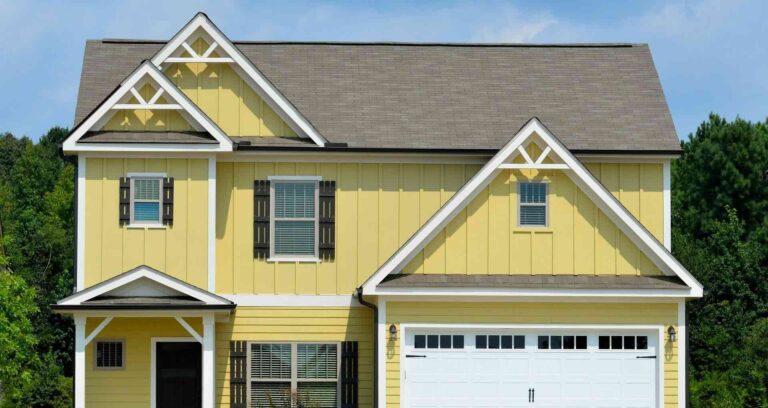
- Hardie panel vertical siding—Large 4×8 or 4×10 sheets in smooth, stucco, or wood-grain finish. Combined with trim battens, this creates the board and batten siding look that’s exploded in popularity for farmhouse and modern designs.
- Hardie architectural panel—Premium panels for modern and contemporary designs, with grooved or smooth profiles.
- Hardie trim boards, soffit, and fascia—Nonsiding accessories that round out a full Hardie exterior package and protect transitions where moisture commonly intrudes.
Hardie Board vs. Other Siding Options
How does Hardie stack up against what else is out there? The short version: better than most, more expensive than vinyl.
Hardie Board vs. Vinyl Siding
Vinyl siding wins on upfront cost and ease of installation. Hardie wins on everything else: lifespan, fire resistance, curb appeal, resale value, and weather durability.
Vinyl typically lasts 20 to 40 years and costs $3 to $8 per square foot installed (see our analysis of how long vinyl siding lasts for the details). Hardie lasts 30 to 50 years at $6 to $13 per square foot. If you plan to stay in your home long-term or sell in an area in which buyers reward premium exteriors, Hardie usually wins the math.
Hardie Board vs. Wood Siding
Real wood siding offers a warm, natural appearance, but demands constant attention. You’ll need to repaint or restain every three to seven years, repair rot and woodpecker damage routinely, and treat for termites, none of which apply to Hardie.
Hardie Board vs. LP SmartSide Siding
LP SmartSide’s engineered wood, wood strands bonded with resins and treated for moisture and pest resistance. It’s lighter than Hardie, easier to install, and slightly cheaper.
Hardie wins on fire resistance because LP SmartSide burns while Hardie doesn’t. Hardie also wins on long-term durability. LP SmartSide can be a good middle option for homeowners who want better-than-vinyl performance without Hardie’s installation complexity, but for fire-prone areas Hardie remains the clear pick.
Hardie Board vs. Brick or Stone
Brick and stone outlast Hardie, but cost two to four times as much. Hardie often gets paired with brick or stone accents on Southeast homes: brick on the lower level and Hardie lap or shingle above.
Why Hardie Board Works So Well in the Southeast
Climate’s the main reason that Hardie has captured market share in Alabama, Georgia, North Carolina, and Tennessee.
The Southeast hits siding with a brutal combination of tough weather: 90-percent-plus summer humidity, sustained UV exposure, severe thunderstorms with hail, and occasional hurricane-force winds reaching inland from the Gulf and Atlantic. In addition, homeowners in our region have to contend with termite pressure that’s among the highest in the country per guidance from the U.S. Department of Agriculture Forest Service on building in termite-active regions.
Hardie’s HZ10 product line’s engineered specifically for this climate. The boards include moisture-resistant additives, UV-stable colorants, and dimensional stability features tuned for the Southeast’s wide temperature and humidity swings.
For coastal homes in Georgia and North Carolina, Hardie also resists salt air better than vinyl or wood. That’s important for properties in Wilmington, Charleston, Savannah, and the Outer Banks.
Hardie Siding Installation and Maintenance Basics
Installing Hardie board’s a job for certified pros. James Hardie maintains a contractor program called the James Hardie Alliance, and using an Alliance contractor preserves your full warranty.
A typical install takes one to three weeks for an average-sized home, depending on size, complexity, and tear-off requirements.
Maintenance is simpler than you’d think:
- Annual cleaning—Rinse with a garden hose using a soft brush. Start at the top and work downwards. Skip the pressure washer because it can damage the finish and void your warranty.
- Inspection—Walk the perimeter once a year and look for caulk failures around windows, doors, and trim. Touch up as needed.
- Trim vegetation—Keep shrubs and tree branches off the siding to prevent moisture trapping and physical damage.
- Recaulk—Plan to recaulk seams and joints every 10 to 15 years.
- Repaint (if applicable)—Refresh primed boards that were repainted on site every 12 to 15 years. ColorPlus stays vibrant longer.
Is Hardie Board Siding Worth It?
For most Southeast homeowners staying in their home five years or more, yes.
You’re paying more upfront for a product that lasts twice as long, looks better, and recoups most of its cost when you sell. You also get fire protection, pest resistance, and immunity to the humidity damage that eats other materials alive.
However, it’s probably not the right call if you’re flipping a property, only plan to stay one to a couple of years, or have a tight budget where vinyl frees up cash for other priorities. In those cases, quality insulated vinyl can deliver good performance for less money.
For everyone else, Hardie board earns its reputation.
If you’re ready to consider it for your home, request a free in-home consultation.
Reference Sources:
- ASTM International, formerly the American Society for Testing and Materials (ASTM): ASTM E84-21a: Standard Test Method for Surface Burning Characteristics of Building Materials
- ASTM International, formerly the American Society for Testing and Materials (ASTM): ASTM E136-22: Standard Test Method for Assessing Combustibility of Materials Using a Vertical Tube Furnace at 750 °C
- Occupational Safety and Health Administration (OSHA): Respirable Crystalline Silica Standard
- The Journal of Light Construction (JLC): Cost vs. Value: 2025
- U.S. Environmental Protection Agency (EPA): Asbestos
Frequently Asked Questions (FAQ) about Hardie Board Siding
Take a look at the answers we’ve assembled to the questions Southeast homeowners ask most often when considering a Hardie board project.
How long does Hardie board siding last?
With proper installation and routine maintenance, Hardie board lasts 30-50 years. James Hardie offers a 30-year nonprorated warranty on the substrate and a 15-year warranty on ColorPlus finishes. For a comparison, see our examination of vinyl siding lifespan.
Is Hardie board waterproof?
It’s water-resistant, but not waterproof. The boards themselves don’t absorb water the way wood does, but seams, joints, and penetrations need proper caulking and flashing to keep moisture out of the wall assembly.
Can Hardie board siding be painted?
Yes. Primed Hardie boards are designed to be painted, and prefinished ColorPlus boards can be repainted when you’re ready for a new look. Use 100% acrylic exterior paint and follow James Hardie’s repaint guidelines.
Does Hardie board increase home value?
Yes, significantly. Zonda’s 2025 Cost vs. Value Report puts fiber cement ROI at 113.7% nationally, among the highest of any home improvement project. Appraisers and buyers both recognize Hardie as a premium upgrade.
Is Hardie board siding fireproof?
It’s noncombustible per ASTM E136 and earns a Class A fire rating per ASTM E84. That doesn’t mean your house can’t burn (the structure underneath can), but the siding itself won’t catch fire or spread flames.
Can I install Hardie board myself?
You can, but most homeowners shouldn’t. The material is heavy, requires specialized cutting tools, generates regulated silica dust, and must be installed to strict specifications to keep the warranty valid. Hire a James Hardie Alliance contractor like Pinnacle Home Improvements instead.
What’s the difference between Hardie board and fiber cement?
Hardie board’s a brand of fiber cement siding made by James Hardie. Other fiber cement brands like Allura, Nichiha, and CertainTeed Weatherboards exist, but James Hardie dominates with about 90% of the U.S. fiber cement market.
How much does it cost to install Hardie board siding on a 2,000-square foot home in the Southeast?
Plan on $12,000-26,000 installed, depending on style, finish, and whether tear-off is needed.
Ready to See Whether Hardie Board’s Right for Your Home?
Hardie board siding delivers a rare combination across the Southeast with looks that hold up and weather resistance that handles whatever Alabama, Georgia, North Carolina, and Tennessee throw at it. Best of all, it has an ROI that beats most other home improvements.
If you’re ready to talk numbers for your home, our team installs Hardie board throughout the Southeast and can walk you through styles, colors, and exact pricing for your project. Pinnacle Home Improvements is proud to maintain an A+ rating with the Better Business Bureau (BBB). We’ve been voted “best siding company of 2025.”
Request an appointment today, and we’ll come to your home to measure, discuss whether Hardie board siding fits your situation, show you the actual products we install, and put real numbers in front of you. No high-pressure sales pitch, no surprise add-ons later, just straight answers.